Colony Flow!
- 4.5
- Rating
- 1.00M
- Installs
- Free
- Price

 Analysis by App-foxy
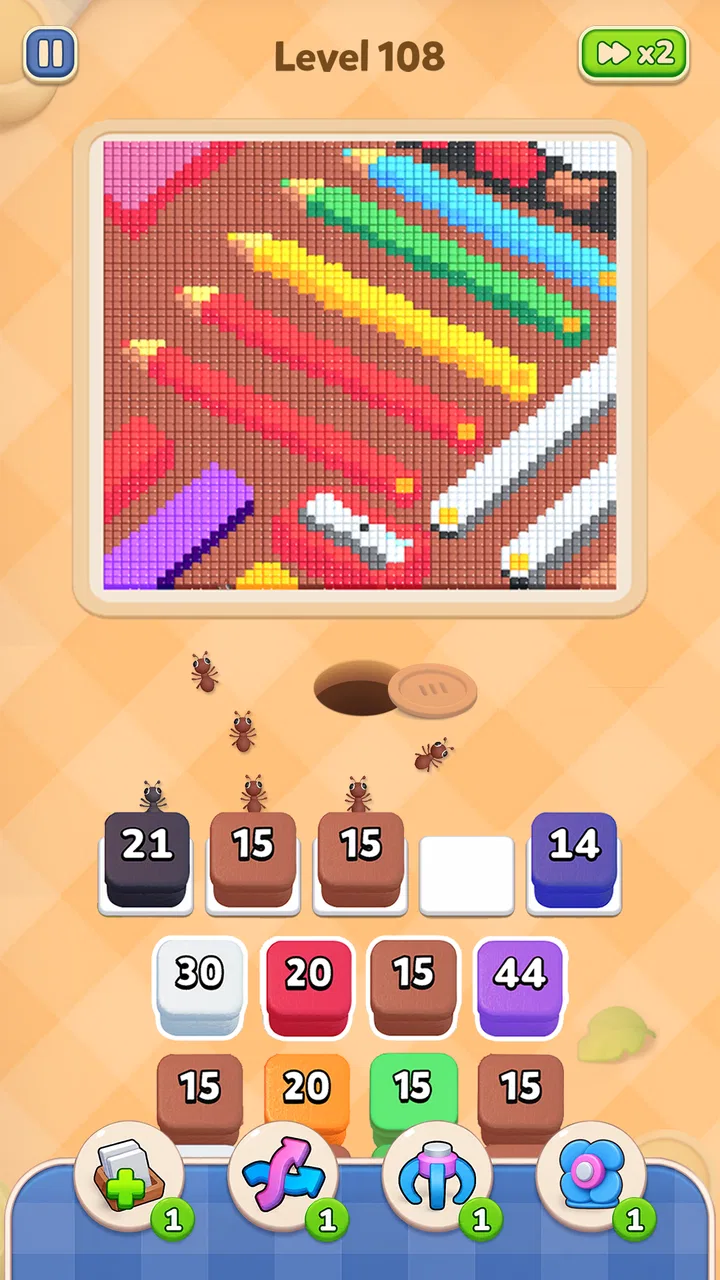
Colony Flow! is a puzzle game built around a simple but surprisingly demanding idea: guiding ants while sorting colorful cubes into the right arrangement. I found that its real appeal is not the cheerful presentation alone, but the way each level asks me to think about movement, order, and timing at the same time. It is the kind of game I can open for a short break, yet some puzzles make me slow down and plan several moves ahead.
Developed by ABI GAMES PTE. LTD., the game is free to download and aimed at Everyone. It has attracted over a million installs and holds a 4.1 average from around twenty-nine thousand ratings, which gives a useful sense of its broad appeal without suggesting that every player will enjoy the same pace. The current version is 1.0.52, and it runs on Android 7.1 or later.
Why the ant-guiding mechanic matters
The central capability is directing a colony through a colorful sorting puzzle. That sounds straightforward until the pieces begin to interact with the path I want to use. Instead of treating each move as an isolated tap, I have to consider how one ant’s route affects the space available for the others and whether moving a cube now will make the next part easier or harder.
You May Also Like

 Blood Strike: 2.5 Anniversary
Blood Strike’s Loadouts Turn Every Drop Into a Tactical Gamble
A close look at Blood Strike’s custom loadouts: how fast access to signature weapons reshapes its battle royale rhythm, rewards preparation, and narrows the gap between fights.

 Pandora - Music & Podcasts
Pandora’s Music Is Easy to Start, but Harder to Recover
Pandora’s strength is its low-effort path from a seed to a station. Its weak spot is how much confidence it asks you to place in connection, setup, and quiet recovery.

 8 Ball Pool
 Is Built on Rivalries, Rematches, and Routine
A close look at the rivalries, rematches, shared routines, and unanswered safety questions that turn a quick pool match into a persistent mobile community.

 Samsung Music
’s Quiet Strength Is Playing What You Already Own
Its reach comes less from spectacle than from dependable access to a personal library. That simplicity is both the app’s strongest retention engine and its ceiling.

 AccuWeather: Weather Radar
AccuWeather Review: A Quick, Clear Forecast for Everyday Decisions
For everyday plans, the best forecast is the one you can understand quickly. AccuWeather makes rain timing, radar, and local conditions easy to act on, with a few trade-offs.

 Hill Climb Racing
Why Hill Climb Racing Still Turns Crashes Into One More Run
A tiny car, a bumpy hill and one more upgrade: Hill Climb Racing keeps resurfacing because its simple chaos makes every near-miss feel personal.
More From Our News Desk
View All News


This gives the game more structure than a basic color-matching title. In a typical match puzzle, I can often focus on clearing groups quickly. Here, the satisfying moment comes from finding an order that keeps the board manageable. The colors make the objective readable, while the ants turn the solution into a small traffic-management problem.
The important design choice is that sorting is also route planning. I am not simply looking for the next matching color. I am trying to preserve useful lanes, avoid creating a blockage, and decide whether a short-term improvement will leave a cleaner board afterward. That extra layer is what makes the game memorable for me.
The pixel-art presentation supports this idea well. The visual style keeps the board friendly and easy to scan, so I can concentrate on the arrangement rather than deciphering elaborate menus or effects. The artwork also gives progress a more tangible feeling: completing a puzzle is not only about reaching the next screen, but about unlocking another small visual reward.
How a typical session feels
I usually approach a level by identifying the colors that are easiest to organize first. Open spaces are valuable, so I avoid filling them immediately unless doing so creates a clear route. When several cubes seem equally available, I look at the ant paths rather than the colors alone. A move that appears productive may force a later detour, while a less obvious move can open the board in a much cleaner way.
This is where the game benefits from patience. Fast tapping is rarely the best approach when the layout becomes crowded. I get better results by pausing after each meaningful change and checking which routes remain open. That habit is especially useful for players who enjoy logic puzzles but do not want a timer constantly pushing them forward.
The game also works well as a casual interruption to a busy day. I can play while waiting for an appointment or during a short commute, then stop after a completed puzzle rather than needing a long uninterrupted session. The individual challenge may be compact, but the decision-making gives it more substance than a purely automatic color sorter.
One practical tip is to treat the edges of the board as part of the solution, not as leftover space. I found that placing pieces near an edge can either protect a route or remove an escape option, depending on the order. Another useful habit is to identify the most constrained ant first. If one path has fewer workable choices than the others, solving around that limitation often prevents a later dead end.
What the colorful cubes add to the puzzle
The cubes provide immediate visual information, but they also create a temptation to act too quickly. Matching colors are easy to notice, so my first instinct is often to move the obvious pair. That is not always the strongest choice. The better move may involve preparing the board for a later sequence rather than completing the most visible match right away.
This creates a gentle distinction between recognition and planning. Recognizing the target is easy; deciding when to commit to it is where the challenge lives. I appreciate that balance because it lets the game remain approachable for younger players while still giving experienced puzzle fans something to analyze.
The pixel-art rewards fit naturally into this loop. They give the player a reason to care about solving more than one isolated board, but the artwork does not replace the puzzle itself. If I am already enjoying the route planning, the collection element feels like a pleasant continuation. If I am not enjoying the core sorting, the visual unlocks are unlikely to change my mind.
How it works in everyday play
Imagine having ten minutes before leaving home. I can start a level, inspect the available colors, and make a few deliberate moves without needing to learn a complicated control system. If the board becomes more intricate, I can use the pause between moves to reconsider the order. That makes Colony Flow! a good fit for short, focused sessions rather than background play.
It is also a reasonable choice for someone who wants a puzzle that feels active without becoming frantic. The ants give the board movement and personality, but the main skill remains observation. I am constantly asking where a piece can go, which route will stay open, and whether the current arrangement gives me enough room to recover from a poor decision.
For parents choosing an Everyone-rated game, the accessible visual language is a strength. The objective is easy to understand from the board itself, and the subject matter is light. Still, younger players may need help developing the habit of planning ahead. The game looks playful, but the later reasoning can be more demanding than the first impression suggests.
For adults, the appeal depends on how much repetition feels comfortable. The basic interaction stays centered on ants, cubes, colors, and routes. I enjoy that consistency because it lets me improve at the underlying logic, but players who need constant changes of genre or presentation may find the structure too focused.
Small decisions that improve results
I recommend beginning with a board scan instead of touching the first available cube. I look for three things: the most restricted route, the color with the fewest safe destinations, and the space that must remain open for later movement. This takes only a few seconds and often prevents the kind of mistake that forces me to rebuild the entire plan.
A second useful approach is to separate “progress” from “cleanup.” Moving a cube into a correct-looking position may feel like progress, but it can also make the remaining pieces harder to reach. I try to ask whether the move improves the whole board or merely makes one corner look finished. That distinction is easy to miss and is one of the game’s more interesting tactical lessons.
I also avoid treating a failed attempt as wasted time. When I reach an awkward arrangement, I can usually identify the earlier decision that caused it: a route closed too soon, a flexible piece was committed prematurely, or a constrained color was ignored. That makes replaying feel more purposeful than simply trying random moves again.
These habits are especially valuable for players who normally rely on speed. Colony Flow! rewards a controlled rhythm: inspect, move, reassess, and only then continue. The game does not need elaborate controls to create depth because the board itself supplies the friction.
The best scenario for playing
The strongest use case is a short break when I want something more engaging than scrolling but less demanding than a long strategy game. The levels give me a defined objective, and the sorting mechanic is easy to resume after an interruption. I can play with full attention for a few minutes, put the phone away, and return later without needing to remember a complicated story or resource system.
It also suits players who enjoy visual logic. If you naturally organize objects by color, notice blocked paths, or like solving problems through trial and correction, the design should feel intuitive. The ants make the board feel lively, while the cubes keep the goal concrete.
On the other hand, I would not choose it for a player seeking a competitive puzzle experience built around rankings, fast reactions, or elaborate multiplayer interaction. Its appeal is personal problem-solving. The satisfaction comes from finding a clean solution, not from proving that I can act faster than someone else.
Where the tradeoffs appear
The free-to-play structure is convenient because I can try the game without paying upfront. At the same time, optional purchases range from $1.99 to $99.99 per item, so I would advise checking the purchase controls before handing the device to a child. The presence of a broad purchase range does not affect the basic appeal of the sorting mechanic, but it is an important consideration for anyone managing a family device or a strict entertainment budget.
Another tradeoff is the narrowness of the central loop. The focus helps the game feel coherent, but it also means that players who tire quickly of arranging colors and managing routes may not find enough variety to stay interested. I would choose a broader puzzle collection instead if I wanted word games, physics challenges, and match mechanics in one application.
The game’s accessible presentation can also hide the need for careful planning. Someone downloading it because it looks like a very simple children’s title may be surprised when the board starts punishing careless ordering. I see that as a positive challenge, but it can create a mismatch between expectation and experience.
Compared with a conventional match-three game, Colony Flow! asks for less rapid pattern recognition and more spatial discipline. Compared with a pure pathfinding puzzle, it adds the distraction and charm of sorting colorful objects. That middle ground is its strongest identity. It is not the best replacement for either style in every situation, but it offers a pleasant blend for players who want both.
Who will get the most from it
I think the best audience is anyone who likes compact logic problems with a friendly visual layer. It works particularly well for players who enjoy planning several actions ahead but do not want a complicated interface. The game can also suit families because the objective is readable, although adults should still supervise purchase access when appropriate.
It is less suitable for people who want a narrative-driven adventure, a high-speed arcade challenge, or a puzzle game with a large range of unrelated mechanics. It may also frustrate players who prefer to solve everything through quick experimentation. Here, experimentation helps, but deliberate observation usually produces better results.
Storage and compatibility are straightforward for many older Android devices because the minimum requirement is Android 7.1. That makes it accessible beyond only recent phones, though the actual comfort of play will still depend on the device’s screen and responsiveness. On iOS, I would make the same practical judgment: the game’s value comes from whether the controls feel precise enough for careful placement, not from having powerful hardware.
The developer, ABI GAMES PTE. LTD., has positioned the experience around an immediately understandable concept rather than a dense ruleset. That makes the first few minutes welcoming. The deeper value appears when I stop treating each cube as an isolated target and start reading the entire board as a network of possible routes.
My final recommendation
After spending time with it, I see Colony Flow! as a focused puzzle game with a clear personality. The ants are not merely decoration: they turn color sorting into a question of space, sequence, and controlled movement. That verified capability gives the game its strongest reason to exist, and it is also what separates it from a routine matching title.
I would recommend trying it if you want a free puzzle for short sessions, enjoy visual organization, and are happy to slow down when a board becomes crowded. I would skip it if you need constant novelty, competitive pressure, or a story to drive every session. The optional purchase range is worth keeping in mind, but the core attraction remains the act of finding a route that makes the whole colony work.
For me, the most rewarding way to play is to resist the obvious move, protect open lanes, and solve the most restricted part of the board first. That approach reveals why the game can hold attention beyond its colorful first impression. It is a modest, approachable puzzle built around one well-chosen idea, and when that idea matches your taste, it makes a short break feel genuinely satisfying.
FAQs for Colony Flow!
01What is Colony Flow!?
Colony Flow! is a casual puzzle and strategy game focused on expanding and managing a growing colony. You connect or arrange paths, guide resources, and solve progressively more challenging levels while trying to keep the colony developing efficiently. Its simple controls make it approachable for short play sessions, but later stages require planning, careful positioning, and attention to the order in which you complete objectives.
02Is Colony Flow! free to download and play?
Colony Flow! can generally be downloaded for free, allowing players to try its core gameplay without an initial purchase. However, the exact monetization model may include advertisements, optional in-app purchases, or both, depending on the platform and version available in your region. Before downloading, it is worth checking the store listing for details about ads, paid items, and any age or payment restrictions.
03Does Colony Flow! require an internet connection?
The main puzzle experience in Colony Flow! may be suitable for playing without a constant internet connection, which is convenient when traveling or when mobile data is limited. Nevertheless, certain features—such as advertisements, analytics, updates, cloud-related services, or promotional content—can require connectivity. Availability of offline play may also vary between versions, so players should confirm the current store description.
04Is Colony Flow! suitable for children and casual players?
Colony Flow! is designed to be easy to understand, with straightforward interactions and visually accessible objectives, making it a reasonable choice for casual players and families. The difficulty can still increase as levels progress, so younger children may need help with planning or problem-solving. Parents should review the game’s content rating, advertising policy, and in-app purchase settings before allowing unsupervised play.
05What should I know before downloading Colony Flow!?
Before downloading Colony Flow!, make sure your Android or iOS device meets the requirements shown on the official app store page and has enough available storage for the installation and future updates. Also review permissions, advertising, in-app purchases, and privacy information. The game is best suited to players who enjoy short strategic puzzles rather than fast action, competitive multiplayer, or a story-driven adventure.
Pros
- Relaxing gameplay with gentle pacing and no time pressure.
- Simple controls make it easy for new players to get started.
- Creative colony layouts encourage experimentation and replayability.
- Short sessions work well for casual play on mobile devices.
- Calm visuals and sound create an enjoyable
- low-stress atmosphere.
Cons
- Progress may feel slow for players who prefer fast-paced challenges.
- Limited objectives can make the experience feel repetitive over time.
- Some levels may lack enough guidance for first-time players.
- The minimalist presentation may not appeal to fans of complex strategy games.
- Replay value depends heavily on enjoying sandbox-style experimentation.

Colony Flow!
Gallery